Contents

Lenses at the extreme wide end tend to divide shooters. Some want distortion control and edge-to-edge perfection. Others want portability, flexibility, and a price tag that does not sting. The new Viltrox 9mm f/2.8 Air sits in the latter camp. It is one of the smallest and lightest autofocus ultrawides available for APS-C. It costs $199 (less, actually, during the holiday sale), and on Fujifilm, it delivers a very wide 13.5mm full frame equivalent field of view.
The lens was released a few months ago for Sony and Nikon’s mirrorless mounts, but the Fuji version is only now becoming available and may still not be in stock at some retailers.
I took the lens to the Grand America Hotel in Salt Lake City during the holiday season, which turned out to be an ideal proving ground: tight corridors, extreme lighting contrasts, and lots of small reflective details. Using IBIS, the 9mm focal length can be handheld with some shooting discipline at 1/10, making it highly flexible for a walkabout lens. After several hours of real-world use, the Viltrox quickly showed both its strengths and its limits, and it did so in a way that makes a lot of sense for its place in the market.
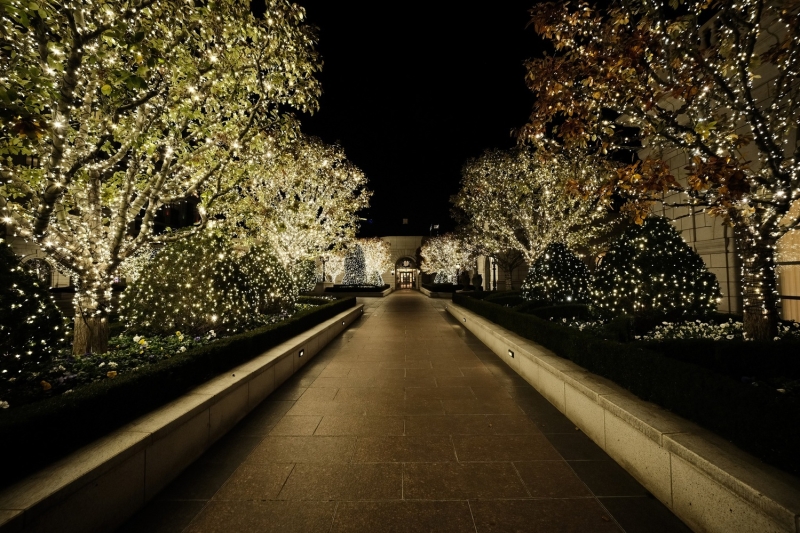
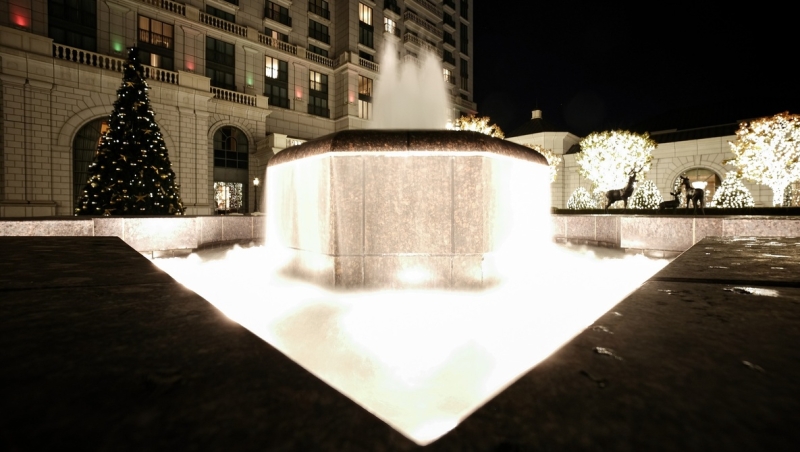
Handheld shooting in the dark? At only 9mm, you can easily get 1/100 SS if your body has IBIS, and even if it doesn’t, 1/20 is very possible.
Build and Handling
The Viltrox 9mm f/2.8 Air lives up to the “Air” name. It weighs roughly 175 grams and is genuinely pocketable. It uses a plastic exterior, a plastic manual focus ring, and a metal mount. The lens is not weather sealed, but it does include a USB-C port for firmware updates, which Viltrox has been good about supporting on other lenses.
Despite its simplicity, the lens feels fine in use. The manual focus ring turns smoothly. The 58 mm filter thread is a practical advantage for people who use circular filters. The small petal lens hood is minimal but functional.
It is not a premium-built lens, and Viltrox never pretends it is. It is built for shooting, not for shelf appeal.
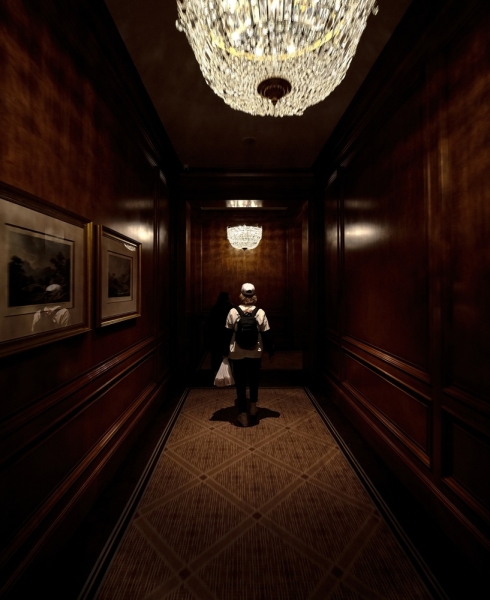
Although this image is cropped to my tastes, I took this photo while trying to maintain my distance to the subject. Despite the dark halls, the lens readily locked on. The autofocus feels snappy and accurate, and shifting focus from near to far or vice versa is near instantaneous.
Autofocus
Autofocus is one of the Viltrox’s standout features. The STM motor is quiet and accurate, and it performed well even in dark hallways and mixed lighting. Eye and subject tracking worked as expected, which is unusual at this focal length. Most manual focus ultrawides rely on hyperfocal techniques, but having autofocus on a 9mm is more useful than you might think when working quickly.
For fast-paced situations like real estate walkthroughs, documentary shooting, or interior event coverage, the autofocus alone gives this lens a major practical advantage. For video, the inclusion of autofocus instantly makes it stand out in a field of mostly manual focus competitors, and although some will argue lenses this wide don’t need autofocus for video, when you consider the relatively large aperture and good close focus, things like vlogging benefit dramatically from the inclusion of autofocus.
Image Quality
Center sharpness at f/2.8 is excellent. In my hotel shots, the fine cabinetry, marble textures, and decorative woodwork all held detail well. The corners start softer wide open, but stopping down to f/4 and f/5.6 improves them significantly. At typical landscape or architectural apertures starting around f/5.6, the lens performs well across the frame.

Microcontrast and fine details render in a manner I find appealing. The distortion is easily corrected in post.
Distortion
As expected for a 9mm lens at this price, Raw files show barrel distortion. It is not extreme and is easy to correct with standard software adjustments. Once corrected, the lens produces clean, wide frames with predictable geometry.
Vignetting
Vignetting is strong at f/2.8. Stopping down reduces it, but some falloff remains even at smaller apertures. Anyone shooting interiors or architecture will want to plan on correcting the corners in post.
Chromatic Aberration
Based on test data and my own use, chromatic aberration is very well controlled. Despite all the bright holiday light sources in the hotel, I did not see fringing issues in normal use.
Flare
This is the Viltrox’s weakest area, perhaps, but not remotely a dealbreaker. The Grand America’s bright exterior lights and fountain highlights made it easy to see flare and ghosting in video when the lens was pointed toward direct light sources. Some compositions required adjusting angles to avoid artifacts. It is manageable, but shooters who work heavily in backlight will want to be aware of it.
Close Focus
The minimum focusing distance is an impressive 13 cm. That opens up creative possibilities that you normally do not have with an ultrawide. You can get physically close to a subject and still keep it sharp while the environment stretches dramatically around it. Close-up sharpness is strong, which gives this lens more versatility than expected.

The f/2.8 aperture is helpful for my night shooting, and the small size and weight (a pattern with these Air lenses) make the lens a joy to carry and right at home on a gimbal also.
Real-World Shooting
The historic Grand America was a perfect test environment. The Viltrox handled tight corridors and tall ceilings with ease. The 113-degree field of view let me frame entire hallways without stepping back. Exterior shots of the tall Christmas trees and brightly lit fountain demonstrated how dramatic an ultrawide can look at night.
The small size made it easy to move around and react to scenes quickly. The autofocus helped in mixed lighting, where I would normally have to stop and check focus manually. The images did require correction for vignetting and distortion, and flare was noticeable at times, but the overall rendering was sharp, clean, and remarkably solid for a lens this small and inexpensive.
How It Compares to the Laowa 9mm f/2.8 Zero-D
Since I have used the Laowa 9mm f/2.8 Zero-D heavily for architecture and real estate, it is worth addressing how it compares, because they occupy the same focal length but serve different purposes.
The Laowa is designed for precision. Although it is not literally distortion-free, its distortion level is extremely low for such a wide lens. Straight lines stay straight, which is a major advantage for architecture, interiors, and any work where geometry matters.
Its all-metal build feels more substantial. It flares pretty heavily sometimes, but if it’s better than the Viltrox in that capacity, it is not by much. When stopped down, it produces very clean, repeatable results with predictable corner performance, but the workflow can be a little finicky, and my copy has a misaligned infinity point mark.
What the Viltrox Does Better
The Viltrox offers autofocus and significantly lower weight. It costs a fraction of the price. The close focus performance is excellent. The handling is more forgiving, the filter size is more practical, and the portability makes it easy to bring everywhere.
While the Laowa rewards deliberate setup on a tripod, the Viltrox rewards mobility. Both produce sharp images when used well, but they serve different shooting styles. If you are shooting video or vlogging, the Viltrox becomes the obvious choice.
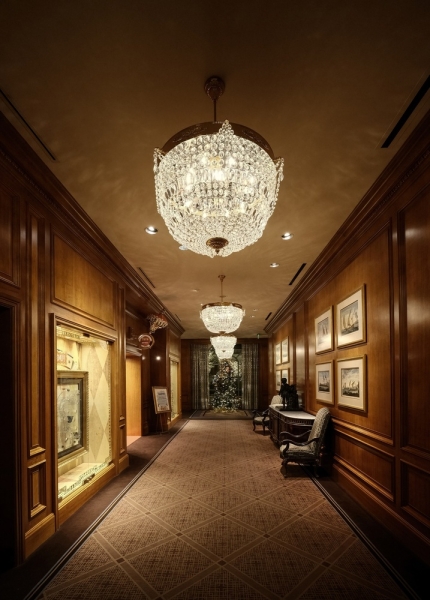
I could wander in this place for days soaking up the old money vibes and photo opportunities.
The Bottom Line
If you shoot strict architecture and need the lowest possible distortion, the Laowa remains the stronger technical tool. If you want a tiny autofocus ultrawide for everyday work, travel, vlogging, interiors, or general photography, the Viltrox delivers an impressive blend of performance and usability for the price. There is room for both lenses in a kit, and they complement each other more than they compete.
What I Liked
- Very lightweight
- Autofocus
- Excellent center sharpness
- Strong close-focusing performance
- Affordable
- 58mm filter thread
What I Didn’t Like
- Heavy vignetting
- Barrel distortion needs correction
- Flares easily
- No weather-sealing
Final Thoughts
The Viltrox 9mm f/2.8 Air is exactly what it sets out to be. It is a compact, inexpensive, ultrawide autofocus lens that produces sharp and very usable images with minimal fuss. Much like the whole Air lineup of lenses, it offers good quality and excellent overall value. It is not a technical architecture lens but still works for that purpose if you make the necessary corrections in post. It offers speed, convenience, and a dramatic field of view in a tiny package. The fact that this lens comes in under $200 is wild. What a time to be alive for photography!