Contents

Astrophotography has been having somewhat of a renaissance over the last few years. Part of that may be the addition of high-quality digital cameras and also computers that can take away the drudgery of aligning the telescope and finding and capturing faint objects.
As a result, we’re seeing a new class of telescopes, called “Smart Telescopes,” that are generally smaller than the norm and are loaded with electronics and run from software on a smartphone or tablet.
The first of the breed was the Seestar S50, introduced in 2023. We reviewed it here. Then the Dwarf Telescope appeared, which I reviewed the same year. Both retailed at around $500 and did a good job of finding galaxies or nebulae and were simple to operate. Because they don’t have equatorial mounts, they can only track for around 10 seconds, and they take hundreds of pictures, which the telescope software assembles into a pretty good image. Longer exposures would be great, but these telescopes can’t take long exposures due to the rotation of the Earth.
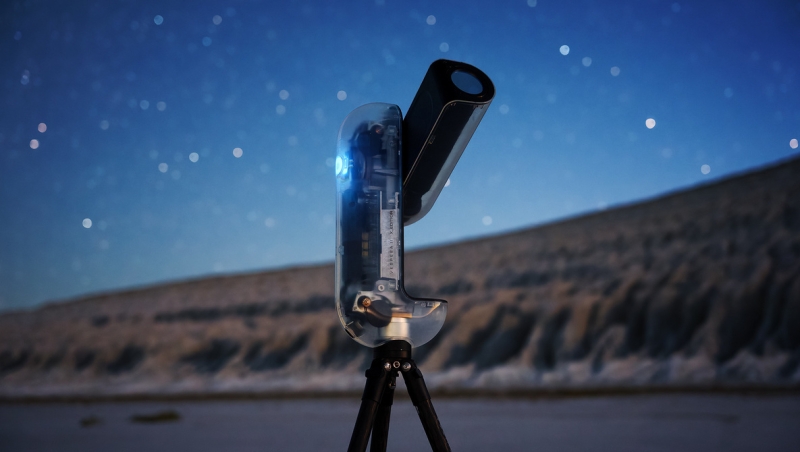
The Vespera II Smart Telescope
Now, we have a newer player in the smart telescope offerings, from Vaonis, a French company founded in 2016.
They were nice enough to loan me their latest telescope, the Vespera II, which outperforms the earlier scopes I’ve mentioned but at a significantly higher price.
What You Get
Vaonis sent me their deluxe telescope, the Limited Edition Vespera II X, which includes a hard protective case and a tall carbon-fiber tripod. You can also buy optional filters for light pollution, solar, and narrowband filters for bringing out nebulae.
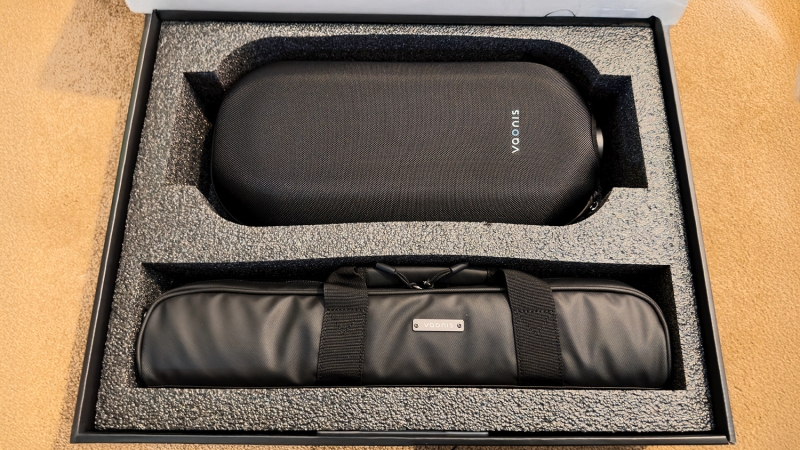
This special X Edition has a clear transparent shell that shows the inner workings of the telescope.
Users will need to download the iOS or Android app that runs the telescope. The app contains an extensive night sky catalog and tells you what the best objects are to see from your location.
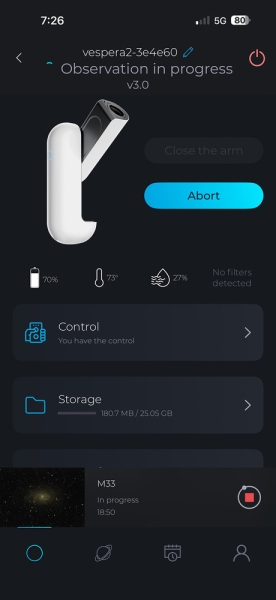
The app connects to your telescope with Wi-Fi by creating its own network.
The software will also update your telescope firmware if needed.
The Specs
The optical and mechanical specs are a cut above most of the less expensive smart telescopes out there.
The image sensor is a color Sony IMX585, which is 8.3 megapixels and has a resolution of 3,840 x 2,160. The Vespera II uses a technology called CovalENS, which is like a panorama mode. It transforms 8.3 megapixels into 24 megapixels, and the 2.5° x 1.4° field of view grows to 4.33° x 2.43° or 3.25° x 3.25°, with a resolving power of 2.39 arcseconds.
The Vespera II has:
-
50mm aperture
-
250mm focal length
-
f/5 focal ratio
The Vespera II has 25 GB of internal storage. Between sessions, images can be offloaded by attaching to the telescope via its Wi-Fi network. I think it would be simpler if you could just plug a PC or Mac into the USB-C port and treat the Vespera II as an external hard drive, but they’ve gone for the Wi-Fi method instead.
The Vespera II is made of a premium alloy of aluminum, copper, and other metals. This material offers exceptional durability and strength, comparable to that used in the automotive industry.
The Vespera II weighs 11 pounds. It’s easy to travel with, and setup time is quick and easy.
Using the Vespera II
Astrophotographers who have spent time under the night sky struggling with aligning the scope position and finding objects will find the Vespera II a revelation.
Charge it up using the USB-C port, and you’ll get around 4 hours of operation. If you want to use an external battery, you can greatly extend your imaging time.
Any third-party battery with proper specs will work nicely.
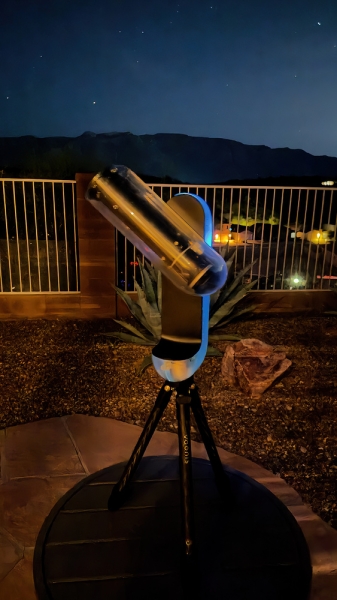
I put the telescope on a steady table in my backyard in Southern Arizona, with the tripod on top. Turn the telescope on (a single button press), and where the telescope is pointed doesn’t matter. It has an internal GPS to get its location, then it rotates skyward and takes a quick image of the stars. From there it performs a “plate solve,” which lets it identify where it’s pointing by comparing its image to an internal catalog. It can take a minute or so, and then it will do a fine focus automatically. That can take a couple of minutes.
From there, you are ready to go. Their app will suggest some targets, or you can browse more deeply. The software will also tell you if your target is in a good position and recommend exposure time. I found the suggested times conservative. You’ll want to collect as many photons as you can. When the image is to your liking, you can stop, and the Vespera II will process the image for you.
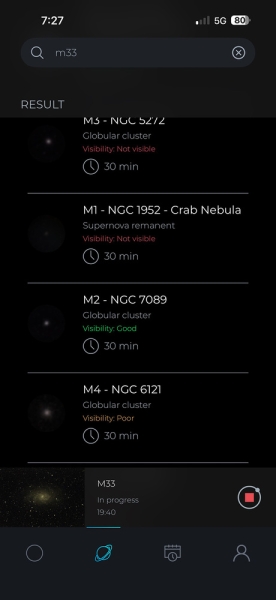
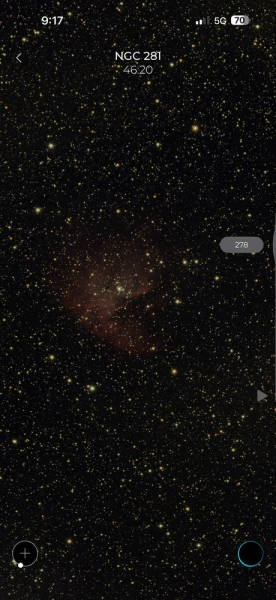
After it gets to the target, the software will start taking an image, 10 seconds at a time. The images it takes will automatically stack, so as you watch the image come in it will get brighter and brighter and more detailed. Here’s the “Pacman Nebula” after a little less than 5 minutes. There’s a finished image later in my review.
Due to the orbit of the Earth, your image will rotate a bit, so the software will counter-rotate the image as it stacks them. This gets around the requirement for an equatorial mount. The telescope will deliver a JPEG, a 16-bit TIFF, or even the raw FITS files for more advanced astrophotographers to use specialized software to process it.
I’m a pretty seasoned astrophotographer, but I was pretty amazed at what I was seeing from the Vespera II. Here’s a 15-minute exposure of M31, the Andromeda Galaxy, I took from my backyard.
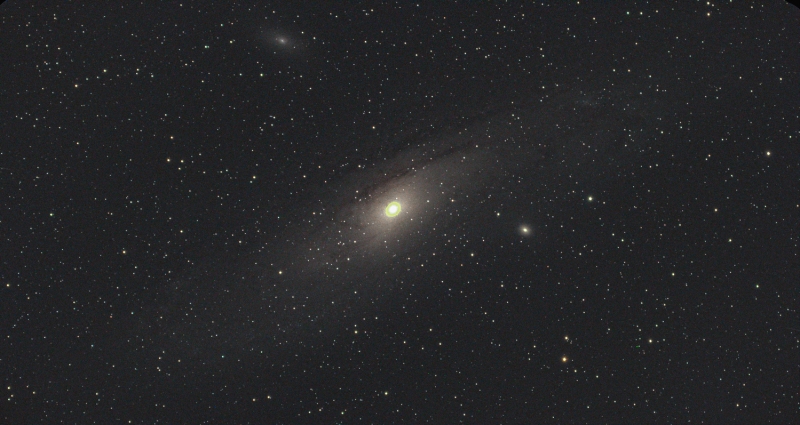
It was OK, but nothing special, so I let the Vespera II run for 2 hours and then did some light processing in Photoshop.
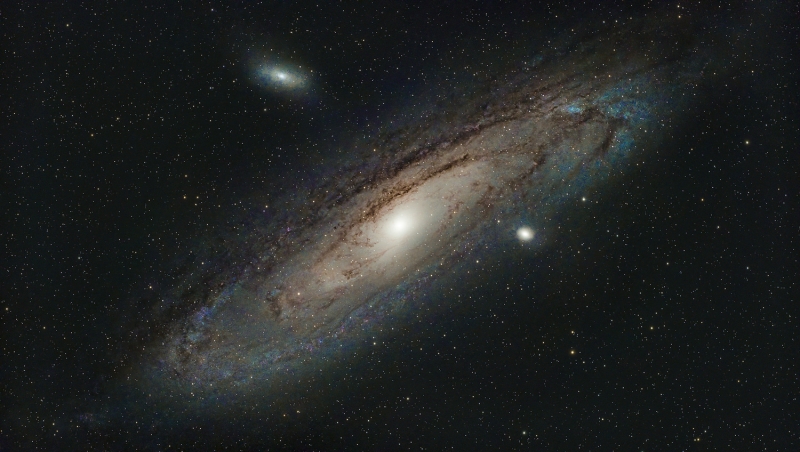
I thought that was a really fine image. It could have been improved with more exposure time and some more processing.
Since it worked so well, I went on to the “Pacman” nebula mentioned above, which is much fainter than the Andromeda Galaxy, and again, I liked the result. This is an hour exposure with the nebula filter.
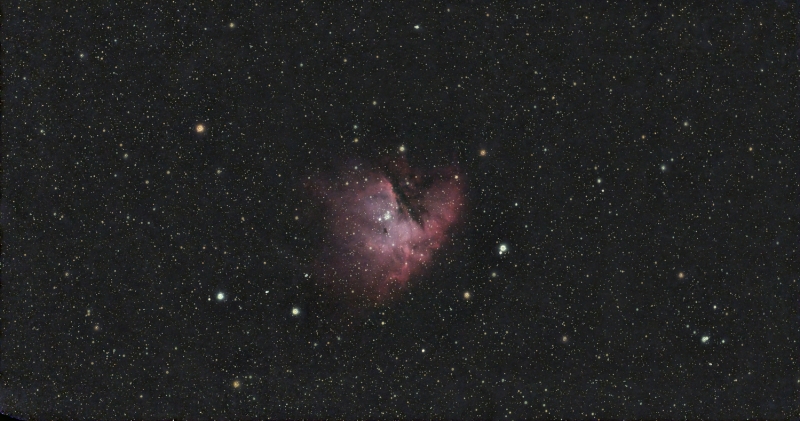
Again, I did some light processing in Photoshop but found this an excellent result from such little effort on my part.
A week later, there was a brightening Moon, which the Vespera II quickly found and accurately focused on.
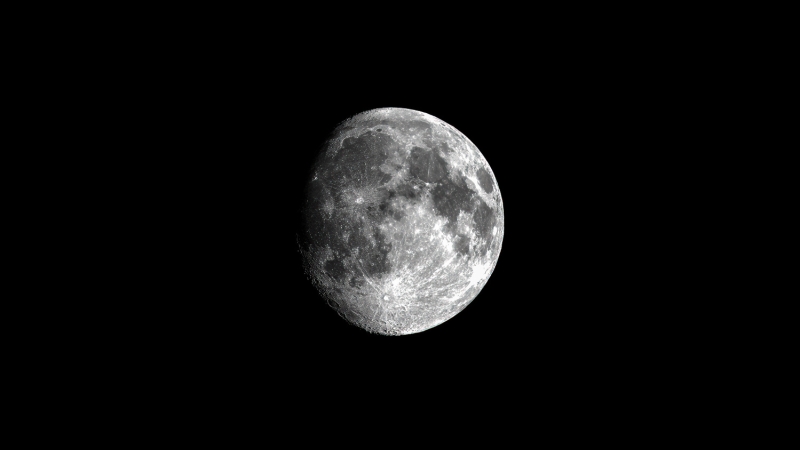
I’ll be the first to admit that a fully functional, equatorial-mounted tracking scope with a computer mount could do better, because it can take longer exposures of, for example, 90 seconds, or 5 minutes, or longer. But these setups have a very steep learning curve. Even some professional photographers I know have given up, so these new smart telescopes, like the Vespera II, make getting good images more accessible.
In astronomy, the more data you have the better, but I think the results of these stacked 10-second exposures are really remarkable.
How Much Does the Vespera II Cost?
The setup I received is not inexpensive but includes the telescope, carbon-fiber tripod, and a nicely built carry case. I was also given a set of filters which at retail is an optional extra. The package retails at $2,490.
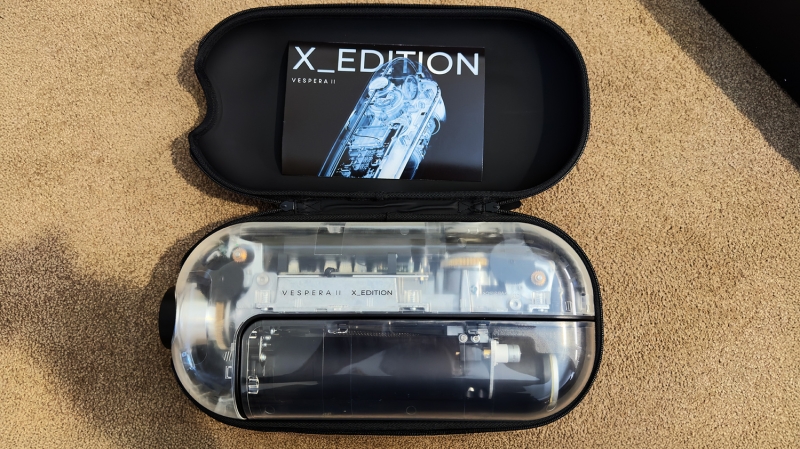
You can also buy the Vespera II without the exotic see-through case, tripod, or filters for $1,730. If you add the carry case and basic tripod it’s $1,840; with the carbon-fiber tripod it totals $1,950.
Is the Vespera II a Good Deal?
Well, you can get the little Seestar S50 for $500. It’s been a successful product for Chinese manufacturer ZWO. So you can buy almost 4 Seestars for the cost of a Vespera II. Still, the French-made Vespera II is better built, has better optics, and more light-gathering power. The software has similar features; both allow you to create mosaics of large portions of the sky, and planning modes let you capture multiple targets while you sleep.
A “good deal” will be defined by each individual. In my purchases I use a cost-per-hour formula. Something expensive that I use a lot is reasonable on a cost-per-hour basis. Something I buy that is inexpensive that is never used I deem to be expensive.
If you have the cash (and remember the Vespera II is only about the cost of a high-quality multi-element DSLR lens), I’d go for it. I’d pass on the clear X Edition. It’s stunning looking but doesn’t make the optics or mechanics any better, and that’s what counts.
What I Liked and What Could Be Better
One can certainly get excellent images with little effort or knowledge. That’s a real plus. In my testing, the Vespera II was reliable and did what I asked it to do. It isn’t hard to learn, and I let some novices try it, and they were getting images without trouble.
This is not a good device for imaging the planets. This is also true of the Vespera II competition. These are wide field telescopes for galaxies and nebulae. Planets are small little dots in this instrument’s field of view. Even the Moon is a little small.
I’d like to see a bigger battery. You’ll be taking multi-hour exposures, and 4 hours of battery life seems a bit stingy. You can solve it by using an external USB-C battery plugged in, but I’d like to see it go longer on its own.
The 25GB internal storage seems a bit small. Remember you’ll be taking an image every 10 seconds and over hours that storage will fill up.
Filters are extra and not inexpensive. The bundle of light pollution, solar, and deep-sky filters costs $804. The bundle includes:
- Light-pollution filter
- Solar filter
- Deep-sky (nebula) filter
Almost everyone who gets this telescope will be in a light-polluted area, and if you are imaging deep-sky objects, a nebula filter is going to be pretty much required. So that’s an added, needed expense. The filters are available individually, so you may be able to eliminate the light-pollution filter, and you may not care about the solar filter, so you’ll be saving some cash.
Summing Up
The Vespera II is a fine instrument that is easy to use and will get users great results the first night out. I don’t want to disparage the lower-priced competition. I own a Seestar S50 and have had a lot of fun with it. The Dwarf 3 is also quite nice. Still, the Vespera II is a step up in every way, and while it does cost more, the results are better. As photographers, we know the drill very well of price vs. results. Sometimes, big expenditures reap small incremental benefits.
The Vespera II is highly recommended. Whether it’s going to be used by a seasoned photographer and/or shared with the family, I think it’s a good investment that will result in very stunning astro images. It comes with a 3-year warranty and a 30-day return option.